Thursday, January 21, 2021

First Lady's Choice


Robert Seldon Duncanson (1821-1872), Landscape with Rainbow, 1859, 30 x 52.25", oil on canvas


I didn't catch this pastoral landscape on WSJ Live on Inauguration Day, but perhaps some of you watching on television did.  It had been selected by Jill Biden from the Smithsonian Collection to be on prominent display in the U.S. Capital during the inauguration.

The artist, Robert Seldon Duncanson, was one of very few established African-American artists active during the pre-and post-Civil War era.  'Established' meaning he was able to support himself by his art, even to travel to and receive art training in Paris.  These accomplishments are never easy for any artist; Duncanson was extremely gifted but he also worked tirelessly first as a house painter, then as an itinerant portrait painter particularly around Cincinnati and Detroit.  There was little formal art education for most Americans at the time and virutally none for African-American artists, so he taught himself to paint by copying prints and etchings of European artists and sketching from nature as he traveled seeking portrait commissions.  

He also became intrigued by travel prints, exploration journals and how Hudson River School artists whose works he encountered used nature to convey ideas about America and its ideals. With the goal of becoming a landscape artist himself, he came off the road, away from portraits and settled in Cincinnati, which had a large free slave population as well as a strong arts community.  There, in what was then called 'the Athens of the West' and filled with new inspiration, he received an important commission from Charles Avery, an abolitionist Methodist minister.  His work for Avery, combined with Avery's social reach,  cemented Duncanson's career by establishing him within a network of abolitionist patrons who purchased his art, sponsored his trips to study old masters abroad and sustained most of Duncanson's career.

Sadly, that career was shortened by dementia and early death at 51.  It is thought Duncanson's suffering, like perhaps Michaelangelo, Goya, Van Gogh among others, was caused by lead in the paints.  Even by then though he was one of the very few landscape painters of the nineteenth century and achieved levels of success unknown to his contemporaries.  By the 1860's American art critics were proclaiming  Duncanson the "greatest landscape painter in the West" while London newspapers held him in equal regard to other British artists at the time.  He is credited with developing the regional Ohio River Valley art style and to this day the Taft Museum of Art in Cincinnati maintains an artist-in-residence program for African-American artists in honor of Duncanson.

So, the First Lady chose very well indeed.  


Thursday, January 14, 2021

How'd You do That?


Here it is a little closer: 


It's at the highest point of the Church of Sant'Ignazio in Rome, near the Pantheon.  And....it isn't a dome at all. Ie, the ceiling up there is flat.

Backtracking a bit, I was thinking about those high church ceilings and wondering how artists got up there to decorate them. Many of us, particularly those who read Irving Stone's The Agony and the Ecstacy or saw the movie, know Michaelangelo worked from scaffolding to paint the Sistine Chapel ceiling.  He actually designed a unique system of platforms attached by brackets to the Chapel's walls.  This was ingenius (of course), but he never did figure out a way to overcome the physical strain of the increasingly uncomfortable work. Definitely not by lying on his back to paint.  Contrary to the movie image of Charlton Heston, he and his assistants stood and reached above their heads to paint, for years!  Makes my muscles ache just thinking about it.

So far I haven't learned how other artists before the advent of modern technology went about painting those gorgeous vaulted and domed ceilings around the world.  But I did learn about the false dome above which was a major accomplishment in its own right and executed by another Renaissance genius, Brother Andrea Pozzo (1642-1709).

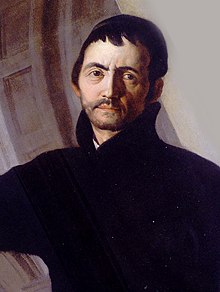
Pozzo may have been a Brother in the Jesuit order, but he appears to be the Father of the illusionistic artistic technique called trompe d'oeil.  The widely traveled virtuoso painter-priest was an expert in mathematics who wrote detailed treatises on theories of perspective. And, when he was put in charge of the interior decoration at Sant'Ignazio from 1685-94, he had a supreme opportunity to put his theories into practice.

The Catholic Church at the time was in the business of winning believers back from the new Protestant orders that had sprung up since Martin Luther.  One of their main techniques was filling their churches with dazzling, theatrical art that stirred the hearts and astonished the minds of worshippers.  So, the original plan for the new Sant'Ignazio church called for an impressive, soaring dome through which the light of the Lord would appear to stream.  

But, some time before completion, either the church ran out of money or the locals objected to a massive dome that would block their sun.  Enter Brother Pozzo who managed to make the bascilica's massive (and flat!) ceiling disappear, opening up an entirely convincing vista into the celestial world above.  What he was standing or sitting or lying on, I don't  know, but, however he did it,  Pozzo's masterpiece is one of the most impressive pieces of artistic illusion ever painted.

Brother Andrea Pozzo, S.J., Self-Portrait, 17th C.

Monday, September 14, 2020

Nothin' But Grey Skies


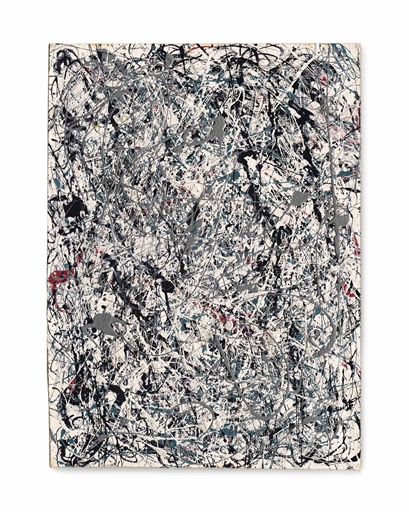
Jackson Pollock (1912-1956) , Number 19, 1954, 30 7/8" x 22 5/8," Paint dripped on canvas.


Our smoky San Francisco skies these days put me in mind of Jackson Pollock's drip paintings. The one above is actually a bit unusual because he signed it upper left as a vertical and it is more 'conveniently' sized than his enormous, wall sized canvases.  But, in May 2013, those things didn't stop someone from buying Number 19 for $58,363,750 at a Christie's auction.

Pollock was famous in his lifetime especially during his legendary burst of creativity from 1947 - 1951 when he had several gallery shows and countless magazine articles written about him.  Fame though  did not equate with agreement among critics and the general public about the quality of his art. Time dubbed  him "Jack the Dripper" while the preeminent critic of the era, Clement Greenberg, championed Pollock so actively he actually organized his first gallery show (which of course got rave reviews).  The wide variety in people's opinions about his art continues to this day and I'm guessing you already have your own, if you've thought of Pollock at all.

Far be it from me to try to change those. But, if you were here, I'm betting we'd agree Pollock's Number 19 is a pretty good likeness of the West Coast sky these days

Saturday, September 5, 2020

Water Lilies, Of Course


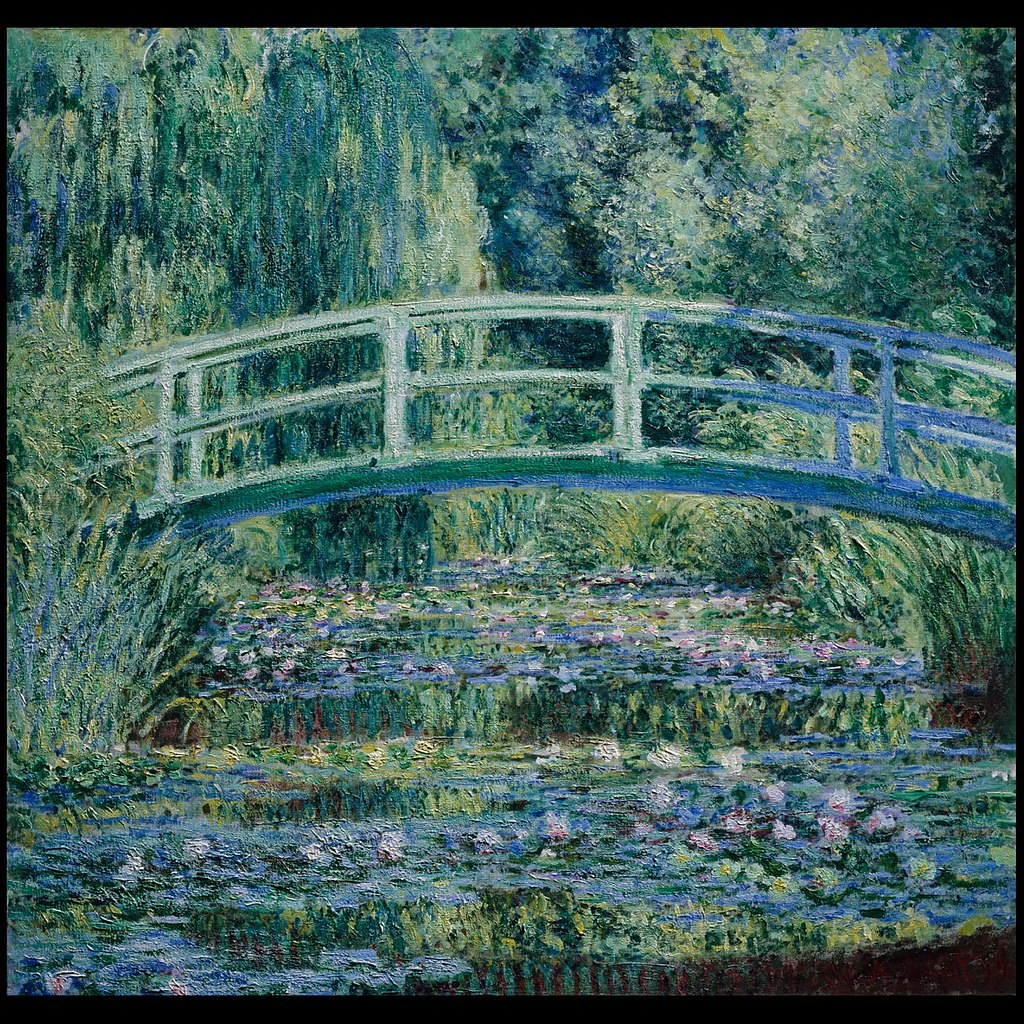
Water Lilies and Japanese Bridge, 1899

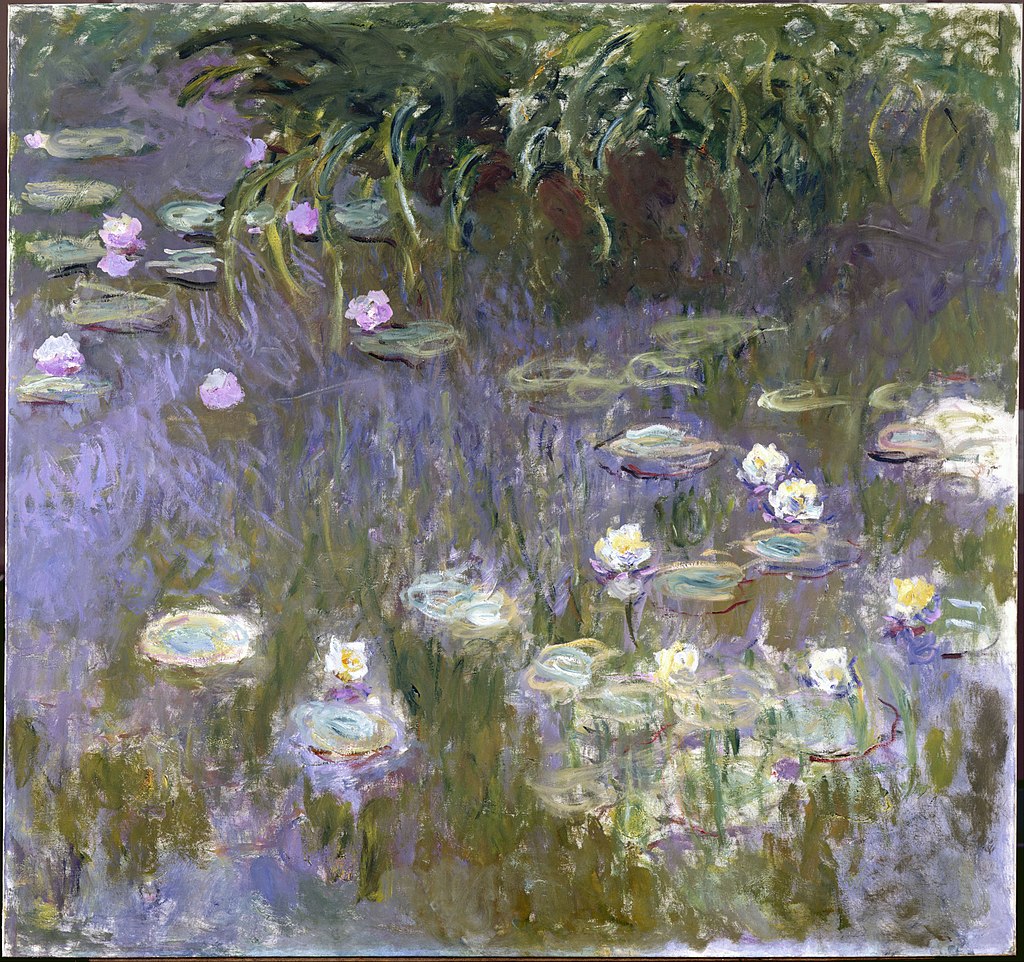
One can't talk about Monet without talking about his 250 Water Lily paintings which depicted the flowers and surroundings of his home in Giverny.  These paintings and the gardens themselves were the primary focus of the last 30 years of his life.  He loved them both, and once said, "Aside from painting and gardening, I am good for nothing."  He also felt he was a better gardener than he was a painter - which is saying a lot!

It is lucky Monet found painting (and selling) the lilies "an extension of my life" because they were also a huge extension of his budget.  He employed six full time gardeners, one of whose daily assignment was to dust and de-pollenate the pads and water so that the colorful light they reflected was pure.  And he actually had a branch of the Epte river diverted to his property to fill his lily pond.  This was much to the objections of his neighbors who were almost successful in preventing one of the most beautiful gardens and series of paintings ever created.

The paintings were  beautiful, life like, refined, sparklng, serene:

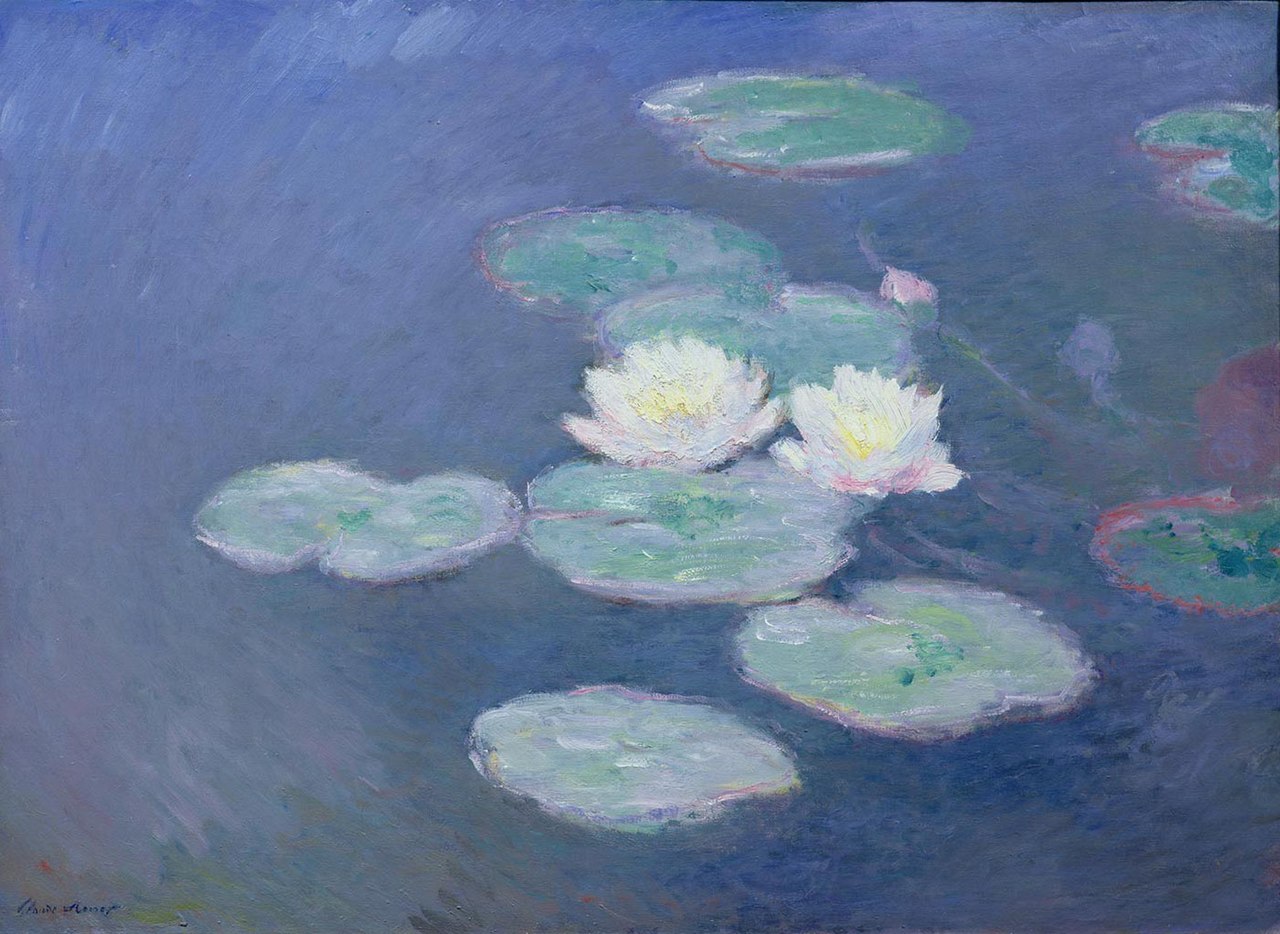
Water Lilies in the Evening, 1896


Until they became fragmented, garishly colored and, in my estimation  just kind of weren't.

Water Lilies, 1922

The reason for the change was cataracts.  Monet began having visual problems as a result of them around 1912 and his palette became gloomier, murkier and less refined.

Japanese Footbridge, 1922


I consider Monet's last years sad because I feels he was.  Sad, lonely without his wife and son, depressed, in pain,  possibly a bit demented and, in spite of a long overdue operation, losing the greated gift he was graced with: his special eye sight.   But there are others who don't see it this way at all. Many of them love the later water lily paintings and some see them as early abstract art.  Oh well, such are the different viewpoints of the art world.   

And really the last word belongs to Claude Monet: Everyone discusses my art and pretends to understand, as if it were necessary to understand, when it is simply necessary to love.


The Elusive Quest

I would like to paint the way a bird sings.  
                                               Claude Monet

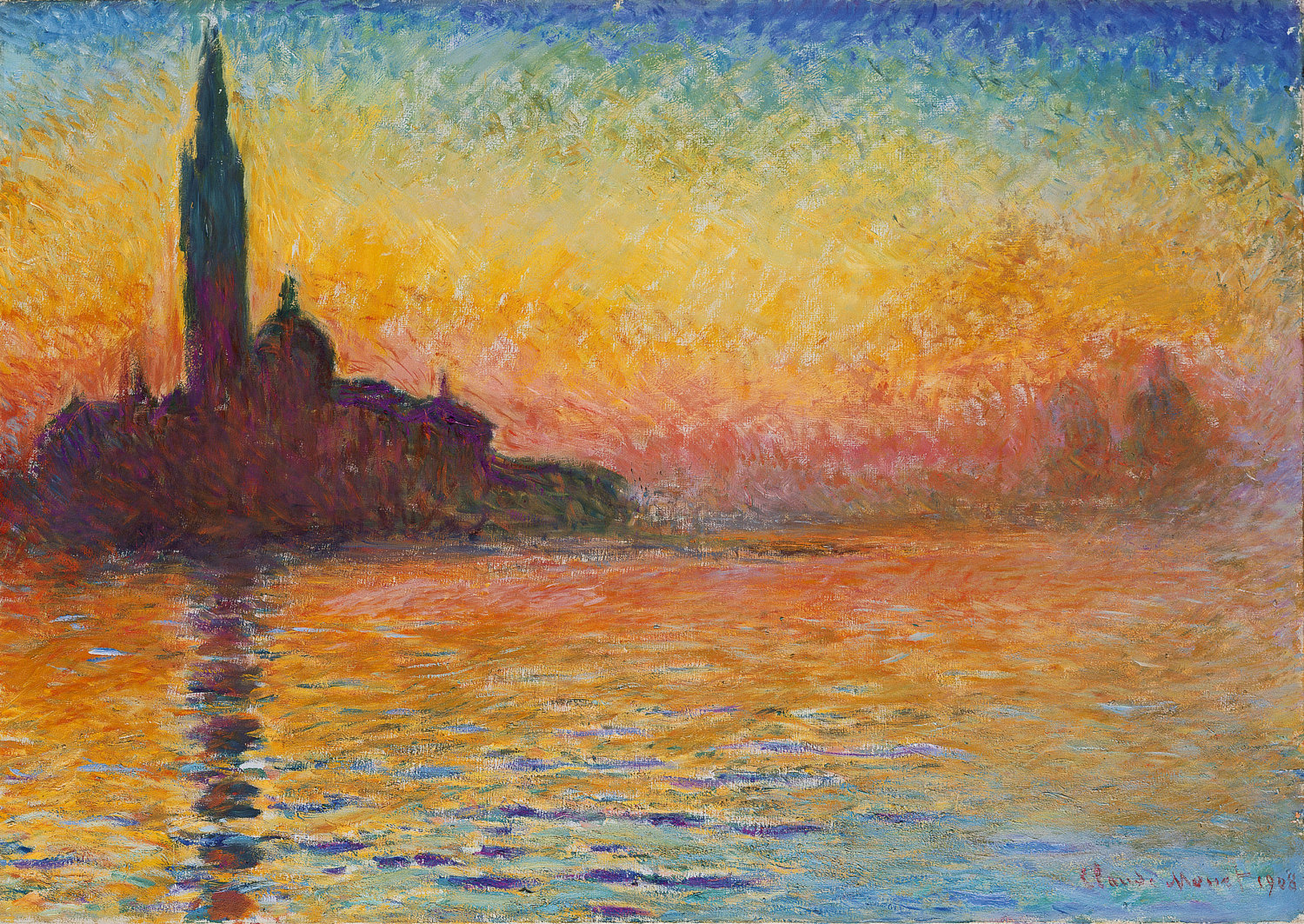
Monet wasn't primarily interested in painting the beauty of nature; he wasn't after a beautiful painting.  He was after nature itself, capturing it.   He didn't see a sea or a cliff or even a water lily.  He saw countless shades of nature's myriad colors; a pink here, a deeper pink there, bright yellow, lilac, the glints of light and color that made up the whole. 

San Giorgio Maggiore at Dusk, 1908 

And it wasn't easy to see this way, to have this drive.  As he said, "Color is my daylong obsession, my joy, my torment."  In search of it he flirted with illness or even death standing in icy sea blasts of sea winds or snowstorms working as one of the first painters to ply his talents 'en plein air,' ie, outside - often all day.  


Cart on the Snow Covered Road with Saint-Simeon Farm, 1865
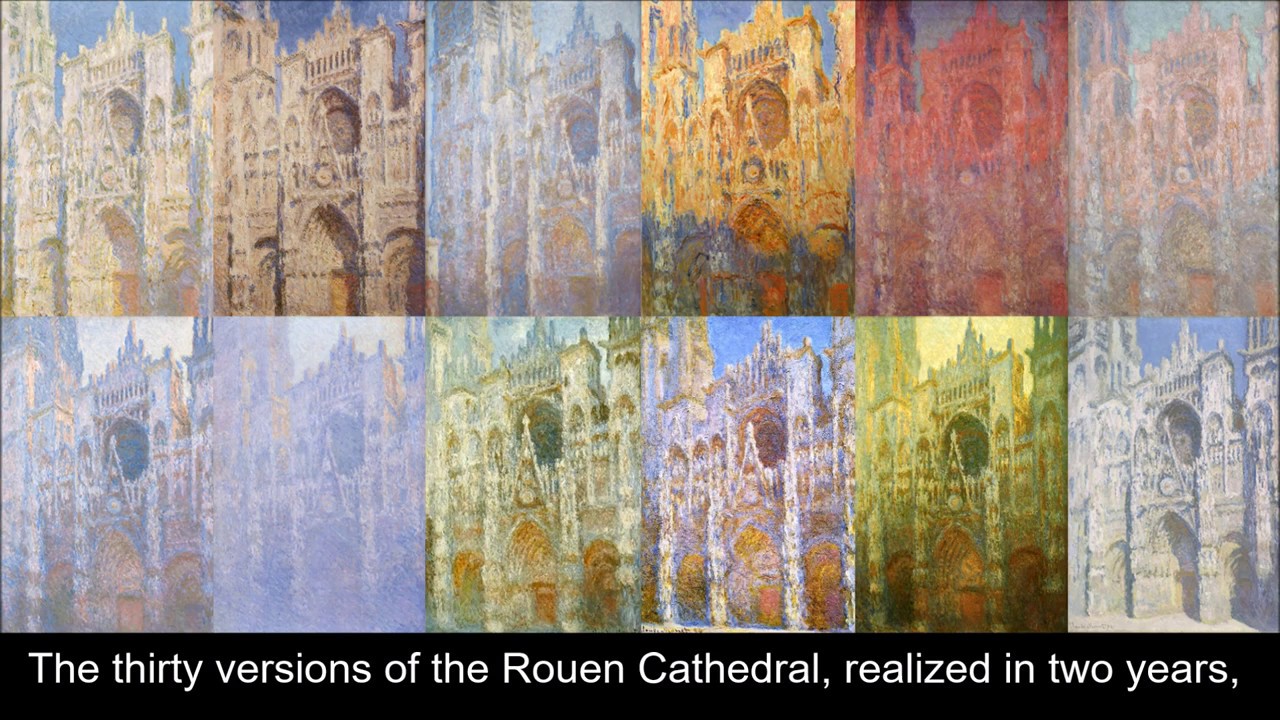
The obsession was there from the beginning and manifested most dramatically in his series paintings.  This practice of painting the same subject at different times of day began in earnest in the 1880's and continued until the end of his life in 1926.  His  most well known series included Mornings on the SeineHouses of ParliamentRouen Cathedral. 


But probably the most significant series for him at the time was his 25 painting Haystack series from 1990-1991.  Fifteen of them were the first to be exhibited as a series.  They were recognized as a breakthrough in French art but, most importantly for Monet, they were immediately popular.  All the paintings in the show sold within days,  and this set him free - at last! - financially.  His reputation and prices rose steeply and he was able to buy outright the house and grounds at Giverny and start constructing a water lily pond.  (NB: He was finally past subsistence living, but never a man to deny himself, he contiued to live at an economic edge.  Another story).


No matter what his subject, Monet's underlying fascination in all his series was light, its intransience.  He needed at the deepest level to capture that.  Even knowing his quest was ultimately impossible, he would rise around 3:30 in the morning so as to see the first light, set up multiple canvases, then paint and move rapidly from one to another as the momentary light changed.  This process was repeated day after day whatever the weather, sometimes for weeks or months until he deemed each canvas as complete as possible.  As he said, "I'm never finished with my paintings; the further I get, the more I seek the impossible and the more powerless I feel."

Monet's series culminated of course in his great and most famous Water Lilies paintings.  More on these in a moment.   

Monet Before MONET


Before Monet became Claude Monet, the Father of Impressionism, around the age of 32, he spent much of his time called by his given name "Oscar," rebellious, impoverished and painting some of my favorites of all his paintings.  Like:

The ENORMOUS (13' x 19/5) and unfinished Luncheon on the Grass, 1865
(This is a smaller version, probably a study, bought directly from Monet by the incredible Russian collector, Sergei, Shchukin, and now in the Pushkin Museum, Moscow

fragment from Luncheon on the Grass

And then when he couldn't finish Luncheon on the Grass in time for the Salon, he painted:
Camille, or Woman in a Green Dress, 1866
In Four days!  AND it was accepted by the picky, picky salon and received great admiration.  He was 26.

At his father's house and probably hoping (to no avail) for some financial help, he painted his father in his garden:

Adolphe Monet Reading in the Garden,  1866


And in the country, painting outdoors and freezing, he was the first painter to correctly capture snow:
The wonderful, wonderful The Magpie, 1868-1869


There are many more favorites from Monet's early years, perhaps more of them than his  later Impressionist paintings so adored by the public.  Perhaps...

Saturday, August 29, 2020

A Masterpiece and A Man --- Day 33


Cathedrale Nortre-Dame de Chartres

So, appropriately because it was Sunday, I took a quick trip to Chartres.  (via Zoom and an artist guide who is leads tours to the site).  It was my first time 'there' and really one of the few times I've been so attentive to the details of church architecture and history.

As architecturally significant and beloved as Notre-Dame de Paris is, turns out Chartres' Notre-Dame is even more so.  The Roman Catholic cathedral is designated a World Heritage Site by UNESCO which deems it "the high point of French Gothic art" and "a masterpiece."  The art expert who presented it on Zoom has returned (from Berkeley) many times and says one should allow at least two days in Chartres to begin to take it in - with all its pilgrimage history, its grand carvings, its stain glass windows, architectural innovations and achievements.

And, truth be told, I am the last person to introduce you to it.  The worst grade I ever got on any paper from kindergarten through graduate school was the one and only architecture paper she ever wrote.  It was a requirement, I chose an I.M. Pei buidling and thought I'd done okay, but was mortified to find I'd been given a D+😒.  So I'll leave the Chartres architecture education (and hopefully even a trip there) to my readers.

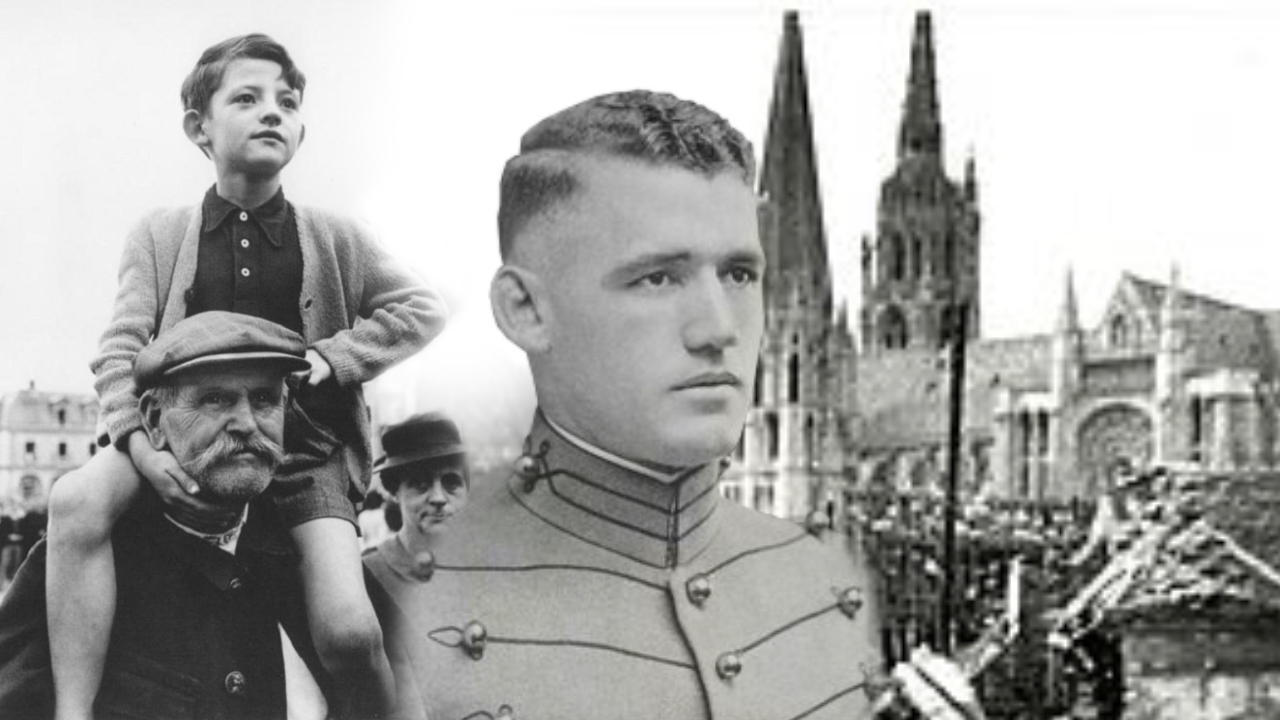
But I do know something about history so I can inform you that, old as Chartres Cathedral is (its North Tower was completed around 1150), it would not be standing today if it hadn't been for an American colonel, Welborn Barton Griffith, Jr.  

Griffith was with the Allies when they entered Chartres in mid-August 1944 in their campaign to defeat Hitler's forces and end World War II in the European theater.  When they got there word was that the Germans were occupying the Cathedral and its steeples and towers were being used as artillery highpoints.  Because of this, the order went out to defeat the Cathedral by any means necessary including completely destroying it with shelling and bombs.  Griffith.who was in charge, and could see first hand the magnificence of the building, questioned this order.  Further he volunteered to be a personal 'canary in the coal mine' and, accompanied by one other brave soldier, walked into the Cathedral.  When he found his doubts were well-founded and the church was empty, he had the church bells rung loudly as a signal not to shoot, the order for destruction was rescinded and the cathedral was saved.

Sadly, Griffith was not.  Later that same day (August 16) he died in combat action near Chartres. For Griffith to take the stance he did to protect the cathedral - much less making a personal reconnaissance accompanied by a single riflemen - was an extraordinary decision.  His feat was not forgotten and posthumously he was decorated with the Croix de Guerre avec Palm, the Legion d'Honneur, and Ordre National du Merite by the French government as well as the Distinguished Service Cross by the American government.

Colonel Welborn Barton Griffith, Jr.