Friday, January 22, 2016

Virgin and Picasso


Those who know Picasso's brutish and misogynistic reputation must wonder about today's headline.  Let Ciwt explain:

Minus the predicted East Coast blizzard, today  Ciwt would be at MoMA at the Picasso Sculpture show, and she'd like to add to her comments on the show even without attending.  (Speaking of Ego).
But first she'd like to give a shout out to Virgin Airlines who gave her a waiver on flight cancellation fees.  Just one more Image result for gold staron the Virgin chart.

Now on to comments on the show not seen.

First, let Ciwt say she has seen some of the best Picasso sculptures in the show, including:
1Image result for picasso sculpture show moma
2Image result for picasso sculpture show moma
3Image result for picasso sculpture show moma
4Image result for picasso sculpture show moma

And several others.  All thought and heart provoking - and often quite amusing.

Which leads to her second comment: The show exhibits over 140 sculptures and Ciwt can't help wondering whether the truly stirring works are swallowed up in the crowd of smaller, (repetitive?, lesser?) works. She assumes so, actually; she has seen this (uncritical) over abundance with other artists in past shows over the years.

And, speaking of crowds, even though Ciwt's MoMA membership allows her to enter the show an hour early, there is still a goodly number of members at that hour.  Then when the timed/non-member admissions begin, the true blockbuster nature of the exhibit takes over.  In these conditions it is virtually impossible to find and read signage or see much much less commune with the art.

So, maybe it is just sour grapes because Ciwt wasn't able to get back for the show(unless she takes a brief, wild, last-minute trip), but Ciwt is thinking she's lucky to have studied Picasso's paintings, drawings and prints so extensively in college and seen so much of his work in the past.  To her, Picasso wasn't (and didn't aspire to be) as talented a sculptor as he was a painter, draftsman and printmaker  - so missing this show is a disappointment but not the end of the world.  On the other hand, the show sounds like an absolute Must See for those beginning to educate their art eyes and What an amazing opportunity to feast them on one of the world's greatest artists being creative, playful, whimsical, and witty.


1. She-Goat, 1950 (cast 1952), bronze
2. Bull, ca. 1958, Cannes, plywood, tree branch
3. Bull's Head, 1942, bicycle seat and handlebars
4. Man with Lamb, 1942, bronze

www.regardingartsf.com


The Child in Us


Pablo Picasso, Woman and Child, 1962, sheetmetal and painting

Before going back East to attend MoMA's Picasso Sculpture exhibition I will be bold to say I believe sculpture was where Picasso went to rejoin those creative child energies he held so dear.

Image result for picasso quote every child is born an artist

www.regardingartsf.com


Will She Grow?


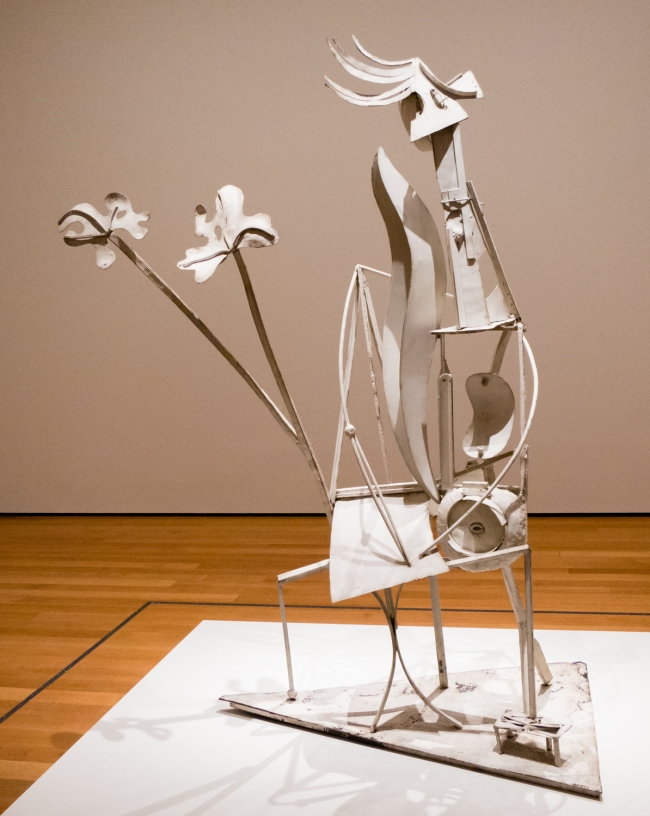
So I will head to the MoMA Picasso Sculpture Show this week and I want to be on record before viewing it that I see his sculptures more as (amusing) pass times, doodles, or ways for him to work out spacial relationships in preparation for a painting. "Woman in the Garden". Paris, 1929-30.  Welded and painted iron.  Musee national Picasso-Paris. Dation Pablo Picasso   In "Picasso Sculpture", MOMA, New York, NY, USA*

I also think Picasso's primary means of expression - the media he most valued - were canvas and paper.  Ie, painting and drawing.  A few of his sculptural pieces I have seen are clearly more important than others and were likely completed for public consumption or display.   Image result for picasso sculpture **  To me, even these do not carry the expressive visceral energy of the paintings and drawings.  Pablo Picasso : goat's skull bottle and candle ***

BUT I haven't seen that many Picasso sculptures in person nor studied in depth the level of Picasso's devotion and relationship to sculpture, so it will be interesting to see if (how, probably) this ambitious, sweeping, 'once-in-a-lifetime' survey expands my understanding and appreciation.

*Woman in the Garden, Paris, 1929-30, welded and painted iron
**The Goat, 1950, Palm lead, iron and plaster
***Goat Skull, Bottle and Candle, 1954, oil on canvas


www.regardingartsf.com

Japanisme, Oui


                                       Henri Guerard (French, 1946-97), Rabbits, woodcut, ink on paper*

So now that I've gotten back to the Asian Art's Looking East show for a more thorough viewing, what did have I concluded?  Well, it's a very high quality show, broad-based from fine art to clothing, furniture, photography, the decorative arts. The signage is thorough and informative and the crowds it is attracting would be the envy of most museums.

What's missing for me is impossible to include.  It's the shock of the new.  Once upon a time, in about 1849 in Paris, virtually no one had laid eyes on anything Japanese.  The operable aesthetic was that of Louis XIV as it had wended its way through rococo, neo-classicism.  It was F-r-e-n-c-h; if you wanted to be chic, in the know, you collected French, hung it on your walls, dressed in it, ate off it and sat in it.  And if you weren't chic, not adhering to the current French mot, well, au revoir to you.

Into this aesthetic stranglehold, slowly began to appear Japanese images: shockingly colorful prints with unheard of proportions and use of lines.  Shortly after the woodblocks came silk tapestries and kimonos with non-heraldic designs like butterflies, cranes, fans and lotus flowers. Then on other boats began arriving dinnerware, desk and table top accessories, screens.  It was all so Decorative and the rage was on!!  People of all classes were wild for the Japanisme; wearing it and collecting it became what status-conscious Parisians simply had to do. The effects were suddenly everywhere from the new more fully realized and sensual view of women (more sexy in their kimonos), to the use of posters for promotion (the beginning of advertising as we know it) , and certainly in painting which was already being transformed (into Impressionism) by new information about the science of light.

In our age, the Eastern aesthetic  - from food, to cars, to gadgets, to iconic designs and a host of other areas -  is one component in daily, globalized life.  So, while there is no shock in the Looking East show, it is interesting and informative to return to a time when the melding of East and West began in earnest.


*Perhaps because the show is tackles such a large and complex topic and includes so many excellent examples of Japanese and French art, I found myself most drawn to this print, one of the simplest images in the show.

www.regardingartsf.com

Friday, December 18, 2015

Essential Home


Johannes Vermeer, The Little Street, ca 1657-1661, 21 3/8" x 17 3/8" oil on canvas

Oh Goodie!!  A Vermeer painting Ciwt didn't know existed until today! And being (always) a homebody and (now) a city person, she was instantly taken by this naturalistic townscape.  It is a slice of daily, domestic 17th century life in Delft so exquisitely rendered that it captures the poetic beauty of and reverence for everyday life throughout Holland. In its tidy, clean, unadorned simplicity, The Little Street is essentially a portrait of Holland.


Detail

In Vermeer's time, the virtuous Dutch home had risen to the level of sanctuary, the seat of the individual soul where all domestic and good citizenship values were modeled and passed on.  Unlike European countries at the time, women's work was highly valued and so was the play of children. Sewing, like spinning was considered an attribute of Biblical origins, and cleanliness, washing and sweeping were associated with spiritual cleanliness and purity.  So too the purity of children who were dressed plainly in frugal, hand-me-down clothes.  All these values and thoughts - and so much more - are rendered easily, naturally and, to Ciwt, with such great love that Vermeer has quietly made his viewer an active participant in The Little Street's silent townscape narrative


This spring, after 320 years, The Little Street will be reunited with the place where it was created. It will be in Museum Prinsenhof Delft from March 25 to July 17, 2016 in case you are planning a trip or live abroad.

Sunday, November 22, 2015

Not Buying


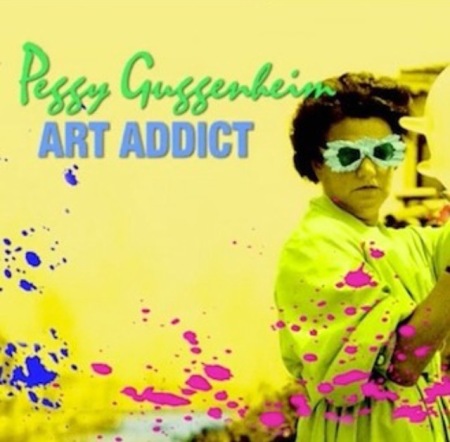
Ciwt didn't buy it: Peggy Guggenheim as "a kind of art collector who never existed before."  This was the central idea that launched and united the documentary Peggy Guggenheim: Art Addict.

Maybe Ciwt has seen too many collectors; virtually all of them become addicts.  Art collecting is addictive.  Also Ciwt can't help but think - just off the top - of the Medicis, the Popes/Catholic Church, Katherine the Great, probably the Pharaohs, the various Emperors of China, and a host of other patron-collectors that existed before and Far surpassed Ms. Guggenheim.

Also the movie supports a certain absence of morality.  For openers, Peggy Guggenheim's atrocious mothering, the constant affairs (This to Ciwt was Guggenheim's true addiction; she labeled herself a nymphomaniac).  The depersonalization, predatory (in her sister's case, murderous) behaviors by virtually everyone we meet in the movie go from there.  Ciwt isn't being a scold, but it seems as if the audience is expected to join the film maker in allowing awe of Guggenheim's alluring riches and high artiness to override common humanity.

You don't learn much in depth about Guggenheim or the myriad of early and mid-20th century artists and advisors who circled around her and she around them (including with most in a carnal sense).  But the movie is a  marvelous 'scrapbook' of these artists and a treasure trove of famous artistic talking heads along with a newly discovered audio of her last interviews.  On that level it is a must see for art lovers of the pre-war avante garde (Duchamp, Tanguy, Magritte, Man Ray, Mondrian, Picasso, the list goes on and on) and the New York School (Pollack, de Kooning, Motherwell, and many more), critics, gallery owners.  They are all there to be seen and heard but not especially understood.

Wednesday, November 11, 2015

Veterans Day, 2015


Winslow Homer (American, 1836-1910), The Veteran in a New Field, 1865, oil on canvas, 24 1/8 x 38 1/8"

To confer honor this Veterans Day, Ciwt can do no better than Winslow Homer and the commentary by the Metropolitan Museum of Art.

Painted through the summer and fall of 1865, not long after the nation came to grips with Robert E. Lee's surrender and mourned President Lincoln's assassination—both of which occurred during the second week of April—Homer's canvas shows an emblematic farmer who is a Union veteran, as is signified by his discarded jacket and canteen at the lower right. The painting seems to blend several related narratives. Most soldiers had been farmers before the Civil War. This man, who has returned to his field, holds an old-fashioned scythe that evokes the Grim Reaper, recalls the war's harvest of death, and expresses grief upon Lincoln's murder. The redemptive feature is the bountiful wheat—a Northern crop—which could connote the Union's victory. With its dual references to death and life, Homer's iconic composition offers a powerful meditation on America's sacrifices and its potential for recovery.